VSCode Remote Containers で Railsの開発環境を作る
VS Code Remote Containers のウィザード?を使えば自分でDockerfile書かなくてもPostgresも一緒に状態で環境作ってくれる様子。
以下手順。
作業ディレクトリを作る。
mkdir rails7_docker
cd rails7_docker
bundle init
VSCodeを開いて Gemfileを以下のように変更。
Gemfile
# frozen_string_literal: true

source "https://rubygems.org"

git_source(:github) {|repo_name| "https://github.com/#{repo_name}" }

gem "rails"
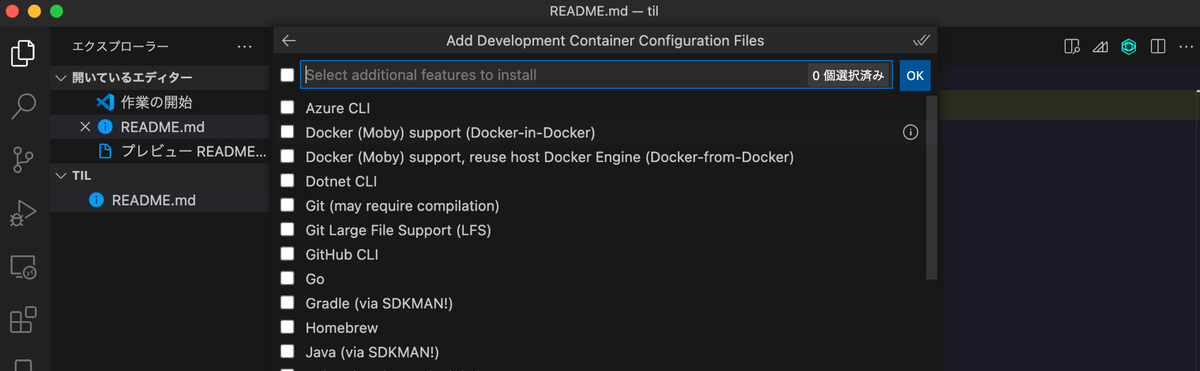
VSCode Remote Container のウィザードにて以下のように選択。
Reopen in container > Ruby3 > Ruby on Rails & Postgres > Ruby3 > Node16 を選択。
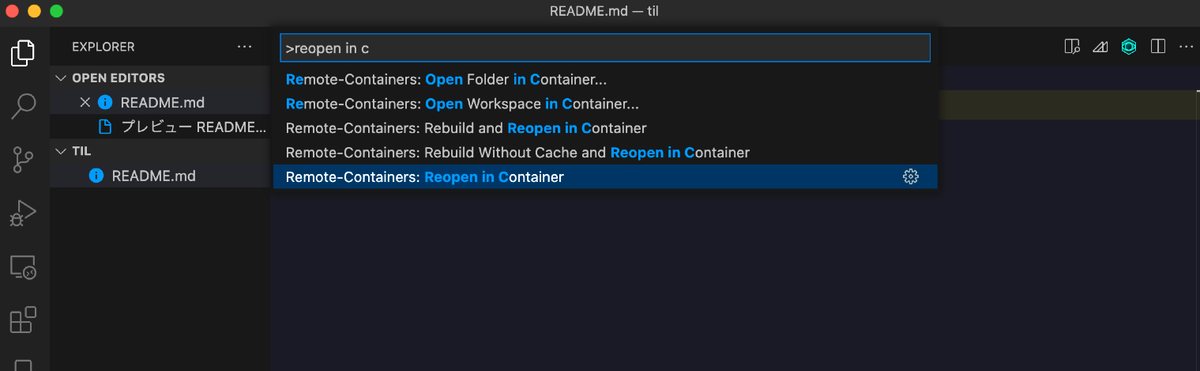
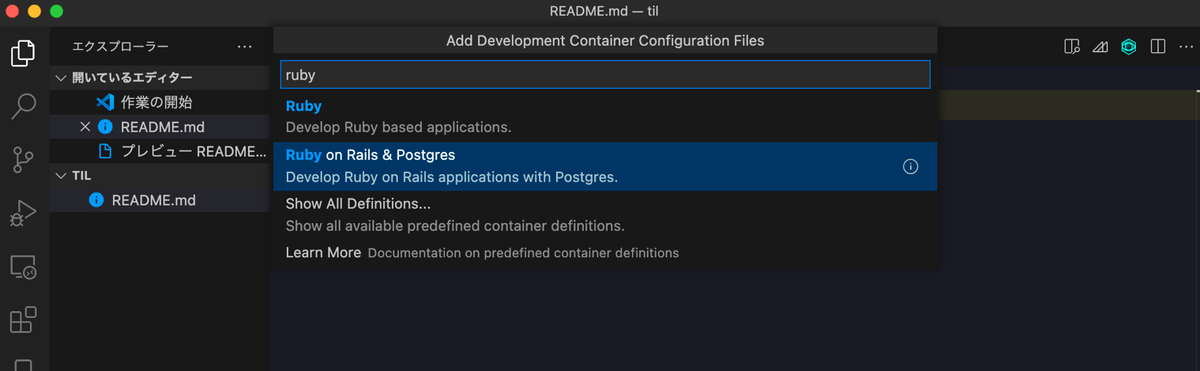
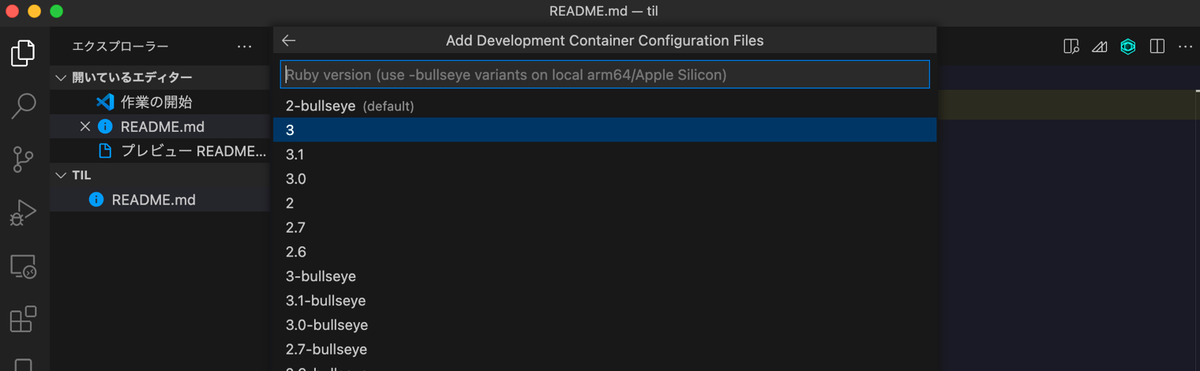
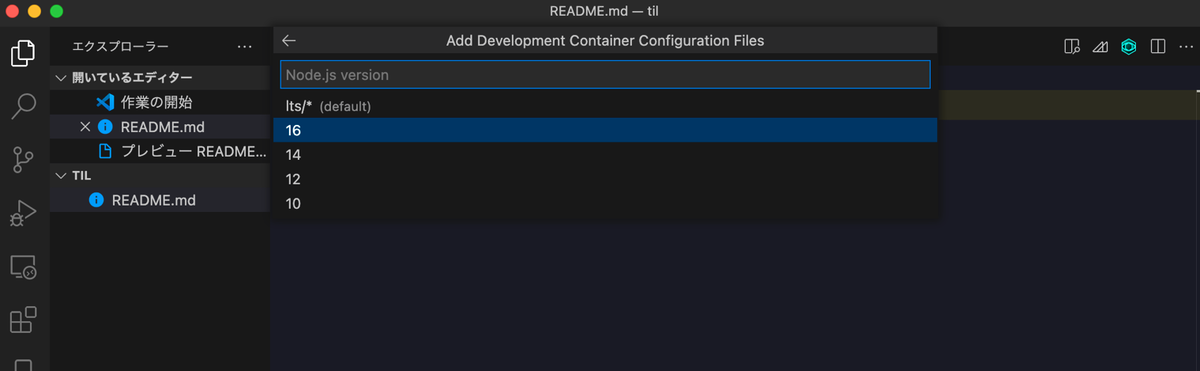
コンテナが起動したら新しいターミナルを開いて rails newを実行。Gemfileを上書きするか効かれるので、Y を入力。
vscode ➜ /workspace $ rails new . --database postgresql
       exist
      create  README.md
      create  Rakefile
      create  .ruby-version
      create  config.ru
      create  .gitignore
      create  .gitattributes
    conflict  Gemfile
Overwrite /workspace/Gemfile? (enter "h" for help) [Ynaqdhm] Y
       force  Gemfile
         run  git init from "."
hint: Using 'master' as the name for the initial branch. This default branch name
hint: is subject to change. To configure the initial branch name to use in all
hint: of your new repositories, which will suppress this warning, call:
hint:
hint:   git config --global init.defaultBranch <name>
hint:
hint: Names commonly chosen instead of 'master' are 'main', 'trunk' and
hint: 'development'. The just-created branch can be renamed via this command:
hint:
hint:   git branch -m <name>
Initialized empty Git repository in /workspace/.git/
      create  app
      create  app/assets/config/manifest.js
      create  app/assets/stylesheets/application.css
      create  app/channels/application_cable/channel.rb
      create  app/channels/application_cable/connection.rb
      create  app/controllers/application_controller.rb
      create  app/helpers/application_helper.rb
      create  app/jobs/application_job.rb
      create  app/mailers/application_mailer.rb
      create  app/models/application_record.rb
      create  app/views/layouts/application.html.erb
      create  app/views/layouts/mailer.html.erb
      create  app/views/layouts/mailer.text.erb
      create  app/assets/images
      create  app/assets/images/.keep
      create  app/controllers/concerns/.keep
      create  app/models/concerns/.keep
      create  bin
      create  bin/rails
      create  bin/rake
      create  bin/setup
      create  config
      create  config/routes.rb
      create  config/application.rb
      create  config/environment.rb
      create  config/cable.yml
      create  config/puma.rb
      create  config/storage.yml
      create  config/environments
      create  config/environments/development.rb
      create  config/environments/production.rb
      create  config/environments/test.rb
      create  config/initializers
      create  config/initializers/assets.rb
      create  config/initializers/content_security_policy.rb
      create  config/initializers/cors.rb
      create  config/initializers/filter_parameter_logging.rb
      create  config/initializers/inflections.rb
      create  config/initializers/new_framework_defaults_7_0.rb
      create  config/initializers/permissions_policy.rb
      create  config/locales
      create  config/locales/en.yml
      create  config/master.key
      append  .gitignore
      create  config/boot.rb
      create  config/database.yml
      create  db
      create  db/seeds.rb
      create  lib
      create  lib/tasks
      create  lib/tasks/.keep
      create  lib/assets
      create  lib/assets/.keep
      create  log
      create  log/.keep
      create  public
      create  public/404.html
      create  public/422.html
      create  public/500.html
      create  public/apple-touch-icon-precomposed.png
      create  public/apple-touch-icon.png
      create  public/favicon.ico
      create  public/robots.txt
      create  tmp
      create  tmp/.keep
      create  tmp/pids
      create  tmp/pids/.keep
      create  tmp/cache
      create  tmp/cache/assets
      create  vendor
      create  vendor/.keep
      create  test/fixtures/files
      create  test/fixtures/files/.keep
      create  test/controllers
      create  test/controllers/.keep
      create  test/mailers
      create  test/mailers/.keep
      create  test/models
      create  test/models/.keep
      create  test/helpers
      create  test/helpers/.keep
      create  test/integration
      create  test/integration/.keep
      create  test/channels/application_cable/connection_test.rb
      create  test/test_helper.rb
      create  test/system
      create  test/system/.keep
      create  test/application_system_test_case.rb
      create  storage
      create  storage/.keep
      create  tmp/storage
      create  tmp/storage/.keep
      remove  config/initializers/cors.rb
      remove  config/initializers/new_framework_defaults_7_0.rb
         run  bundle install
Fetching gem metadata from https://rubygems.org/...........

〜

Using rails 7.0.2
Fetching bootsnap 1.10.3
Installing bootsnap 1.10.3 with native extensions
Bundle complete! 15 Gemfile dependencies, 74 gems now installed.
Use `bundle info [gemname]` to see where a bundled gem is installed.
         run  bundle binstubs bundler
       rails  importmap:install
Add Importmap include tags in application layout
      insert  app/views/layouts/application.html.erb
Create application.js module as entrypoint
      create  app/javascript/application.js
Use vendor/javascript for downloaded pins
      create  vendor/javascript
      create  vendor/javascript/.keep
Ensure JavaScript files are in the Sprocket manifest
      append  app/assets/config/manifest.js
Configure importmap paths in config/importmap.rb
      create  config/importmap.rb
Copying binstub
      create  bin/importmap
       rails  turbo:install stimulus:install
Import Turbo
      append  app/javascript/application.js
Pin Turbo
      append  config/importmap.rb
Run turbo:install:redis to switch on Redis and use it in development for turbo streams
Create controllers directory
      create  app/javascript/controllers
      create  app/javascript/controllers/index.js
      create  app/javascript/controllers/application.js
      create  app/javascript/controllers/hello_controller.js
Import Stimulus controllers
      append  app/javascript/application.js
Pin Stimulus
      append  config/importmap.rb
postgresの接続設定をするため database.ymlを修正。
username, password, db を変更。これらの設定値は .devcontainer/docker-compose.yml に記載されている。
config/database.yml
# PostgreSQL. Versions 9.3 and up are supported.
#
# Install the pg driver:
#   gem install pg
# On macOS with Homebrew:
#   gem install pg -- --with-pg-config=/usr/local/bin/pg_config
# On macOS with MacPorts:
#   gem install pg -- --with-pg-config=/opt/local/lib/postgresql84/bin/pg_config
# On Windows:
#   gem install pg
#       Choose the win32 build.
#       Install PostgreSQL and put its /bin directory on your path.
#
# Configure Using Gemfile
# gem "pg"
#
default: &default
  adapter: postgresql
  encoding: unicode
  # For details on connection pooling, see Rails configuration guide
  # https://guides.rubyonrails.org/configuring.html#database-pooling
  pool: <%= ENV.fetch("RAILS_MAX_THREADS") { 5 } %>

development:
  <<: *default
  database: workspace_development

  # The specified database role being used to connect to postgres.
  # To create additional roles in postgres see `$ createuser --help`.
  # When left blank, postgres will use the default role. This is
  # the same name as the operating system user running Rails.
  username: postgres

  # The password associated with the postgres role (username).
  password: postgres

  # Connect on a TCP socket. Omitted by default since the client uses a
  # domain socket that doesn't need configuration. Windows does not have
  # domain sockets, so uncomment these lines.
  host: db

  # The TCP port the server listens on. Defaults to 5432.
  # If your server runs on a different port number, change accordingly.
  #port: 5432

  # Schema search path. The server defaults to $user,public
  #schema_search_path: myapp,sharedapp,public

  # Minimum log levels, in increasing order:
  #   debug5, debug4, debug3, debug2, debug1,
  #   log, notice, warning, error, fatal, and panic
  # Defaults to warning.
  #min_messages: notice

# Warning: The database defined as "test" will be erased and
# re-generated from your development database when you run "rake".
# Do not set this db to the same as development or production.
test:
  <<: *default
  database: workspace_test

# As with config/credentials.yml, you never want to store sensitive information,
# like your database password, in your source code. If your source code is
# ever seen by anyone, they now have access to your database.
#
# Instead, provide the password or a full connection URL as an environment
# variable when you boot the app. For example:
#
#   DATABASE_URL="postgres://myuser:mypass@localhost/somedatabase"
#
# If the connection URL is provided in the special DATABASE_URL environment
# variable, Rails will automatically merge its configuration values on top of
# the values provided in this file. Alternatively, you can specify a connection
# URL environment variable explicitly:
#
#   production:
#     url: <%= ENV["MY_APP_DATABASE_URL"] %>
#
# Read https://guides.rubyonrails.org/configuring.html#configuring-a-database
# for a full overview on how database connection configuration can be specified.
#
production:
  <<: *default
  database: workspace_production
  username: workspace
  password: <%= ENV["WORKSPACE_DATABASE_PASSWORD"] %>
適当にUserモデルを作ってmigrate。
vscode ➜ /workspace (main ✗) $ rails g scaffold User name:string email:string memo:text
      invoke  active_record
      create    db/migrate/20220210024212_create_users.rb
      create    app/models/user.rb
      invoke    test_unit
      create      test/models/user_test.rb
      create      test/fixtures/users.yml
      invoke  resource_route
       route    resources :users
      invoke  scaffold_controller
      create    app/controllers/users_controller.rb
      invoke    erb
      create      app/views/users
      create      app/views/users/index.html.erb
      create      app/views/users/edit.html.erb
      create      app/views/users/show.html.erb
      create      app/views/users/new.html.erb
      create      app/views/users/_form.html.erb
      create      app/views/users/_user.html.erb
      invoke    resource_route
      invoke    test_unit
      create      test/controllers/users_controller_test.rb
      create      test/system/users_test.rb
      invoke    helper
      create      app/helpers/users_helper.rb
      invoke      test_unit
      invoke    jbuilder
      create      app/views/users/index.json.jbuilder
      create      app/views/users/show.json.jbuilder
      create      app/views/users/_user.json.jbuilder
vscode ➜ /workspace (main ✗) $
vscode ➜ /workspace (main ✗) $ rails db:migrate
== 20220210024212 CreateUsers: migrating ======================================
-- create_table(:users)
   -> 0.0336s
== 20220210024212 CreateUsers: migrated (0.0339s) =============================
rails serverを起動する。
vscode ➜ /workspace (main ✗) $ rails s
=> Booting Puma
=> Rails 7.0.2 application starting in development
=> Run `bin/rails server --help` for more startup options
Puma starting in single mode...
* Puma version: 5.6.1 (ruby 3.1.0-p0) ("Birdie's Version")
*  Min threads: 5
*  Max threads: 5
*  Environment: development
*          PID: 9552
* Listening on http://127.0.0.1:3000
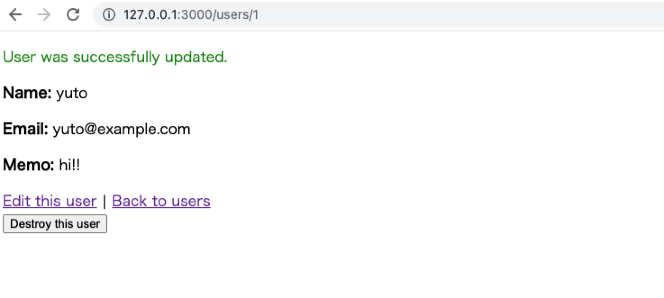
動いた! 👏
Railsの動いているコンテナに psql がインストールされていないので、rails db なんかをしたい場合にはDockerfileに追記する等でインストールしてやる必要がある。
まぁとりあえず開発用途ならこのやりかたで良さそう。
今回作ったリポジトリはここです。
